
Understanding Width to Height Ratio Metrics
Understanding facial width-to-height ratio (fWHR) metrics is essential for accurate facial analysis and aesthetic assessment. Our Face Width to Height Ratio Calculator employs precise measurement techniques to analyze these crucial metrics. This comprehensive guide explores the technical aspects of facial ratio measurements and how to interpret them effectively.
Core Measurement Points
Accurate facial ratio analysis relies on specific anatomical landmarks:
- Width Measurements:
- Bizygomatic width (cheekbone to cheekbone)
- Bigonial width (jaw angles)
- Temple width measurement
- Mid-face width assessment
- Height Measurements:
- Upper facial height
- Mid-face height
- Lower facial height
- Total face height
Key Ratio Calculations
Several important ratios are calculated from these measurements:
- Primary Width-to-Height Ratio: Bizygomatic width / Upper facial height
- Facial Index: Total face height / Bizygomatic width × 100
- Mid-face Ratio: Mid-face width / Mid-face height
- Lower Face Ratio: Bigonial width / Lower face height
Measurement Techniques
Our Face Width to Height Ratio Calculator uses advanced techniques for precise measurements:
1. Digital Analysis Methods
- AI-powered landmark detection
- 3D facial mapping technology
- Automated measurement calibration
- Multi-angle analysis
2. Precision Factors
- Image quality requirements
- Angle standardization
- Lighting considerations
- Distance calibration
Statistical Ranges and Norms
Understanding typical ratio ranges is crucial for interpretation:
- Male Averages:
- Primary ratio: 1.8 - 2.0
- Facial index: 85 - 95
- Mid-face ratio: 1.0 - 1.2
- Female Averages:
- Primary ratio: 1.6 - 1.8
- Facial index: 80 - 90
- Mid-face ratio: 0.9 - 1.1
Measurement Accuracy Factors
Several factors influence measurement accuracy:
- Image Quality:
- Resolution requirements
- Lighting conditions
- Background contrast
- Positioning:
- Head alignment
- Camera angle
- Distance calibration
Interpreting Results
Understanding your measurement results involves:
- Comparison with population averages
- Context-specific interpretation
- Individual variation consideration
- Demographic adjustments
- Aesthetic goal alignment
Advanced Analysis Features
Our analysis tools provide sophisticated metrics:
- Comprehensive Measurements:
- Multiple ratio calculations
- Symmetry analysis
- Proportion harmonics
- Comparative Analysis:
- Population percentiles
- Demographic comparisons
- Trend analysis
Practical Applications
These metrics have various practical applications:
- Aesthetic assessment and planning
- Progress tracking over time
- Treatment outcome prediction
- Personalized enhancement strategies
- Scientific research applications
Measurement Analysis Features

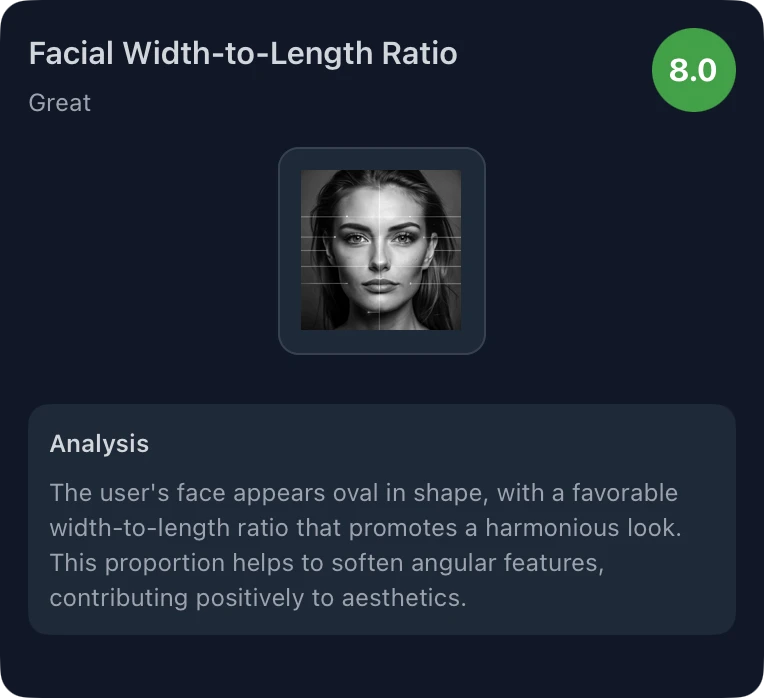
Measurement Techniques Explained
Get the Maxx Report App
Access precise facial measurements and comprehensive ratio analysis with our advanced tools