
FWHR Calculator (Facial Width-to-Height Ratio)
FWHR Calculator
Your facial width-to-height ratio from a selfie — measured from landmarks in your browser, never uploaded.
What you get, free
- ✓Your FWHR (facial width-to-height ratio) and how it compares to the ideal
- ✓Your harmony score out of 10 and your face shape
- ✓FWHR and symmetry, measured from 468 facial landmarks
Free with a Maxx Report account · 4 runs a day · sign in with Google or Apple
Prefer your phone? The same tools are in the app.


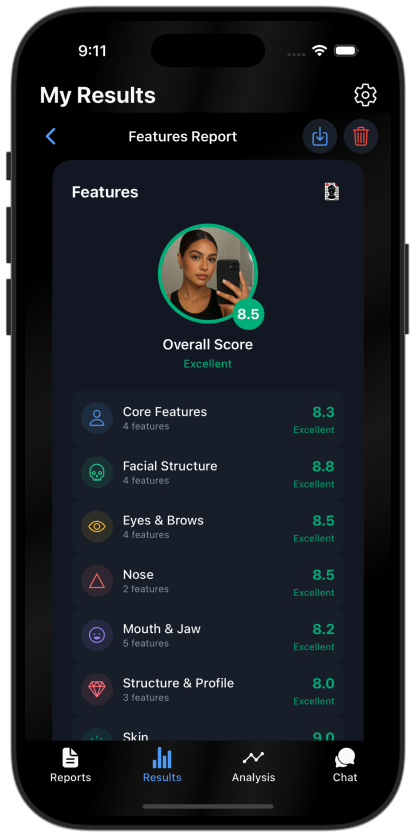
Face Width to Height Ratio analysis is included as part of the comprehensive Features report from the Maxx Report app, which analyzes 24 distinct facial characteristics. The Facial Width-to-Length Ratio component specifically measures the balance between the width and length of your face, providing a 1-10 rating based on how well your proportions align with ideal facial harmony standards.
The Features report precisely calculates your ratio using both front-facing and side profile photos, comparing your measurements to scientifically established ideal ranges. Additionally, the Glow Up report complements this by analyzing how skin quality, texture, and tone affect the perception of your facial proportions, as clearer skin can enhance the appearance of facial structure.
Understanding your width-to-height ratio through the Features report helps guide aesthetic decisions for hairstyles, facial hair, and contouring techniques. Combined with the Glow Up report's skin quality insights, you receive comprehensive guidance for optimizing both your facial proportions and overall appearance.
Width to Height Analysis Features

Facial Width Measurement
Precise analysis of your facial width using advanced AI technology to measure the distance between your most prominent facial points.
Height Calculation
Accurate measurement of your face height from hairline to chin, considering all facial thirds for comprehensive analysis.
Ratio Analysis
Calculate your exact width-to-height ratio, a key indicator of facial harmony and attractiveness according to scientific research.
Ideal Range Assessment
Compare your ratio to scientifically established ideal ranges and understand where your measurements fall on the attractiveness spectrum.
Enhancement Recommendations
Receive personalized suggestions for optimizing your facial proportions through styling, grooming, and other techniques.
Progress Tracking
Monitor changes in your facial proportions over time as you implement recommended improvements and track your progress.
Comprehensive Proportion Analysis Reports
Features Report
Glow Up Report

Get Maxx Report
Ideal FWHR: the science behind the facial width-to-height ratio
Estimated reading time: 8 min
Key Takeaways
- The ideal face width to height ratio (FWHR) is a crucial factor in facial harmony and perceived attractiveness.
- Measuring your FWHR accurately helps you tailor glow-up strategies and grooming choices to your unique features.
- AI-powered tools like Maxx Report provide a personalized looksmaxxing plan based on your FWHR and other facial metrics.
- You can visually improve your FWHR with targeted styling, grooming, and facial exercises.
Section 1: What Is Ideal FWHR?
Understanding Facial Width-to-Height Ratio
The ideal face width to height ratio (FWHR) is a scientific measurement comparing the width of your face (distance between cheekbones) to its upper height (from the upper lip to the mid-brow). This ratio is central to facial symmetry, masculinity or femininity, and perceived attractiveness. Many people search for the ideal face width to height ratio to see how their facial proportions align with beauty standards and to discover ways to improve their facial harmony. If you want to know the ideal face width to height ratio or how to achieve it, you’re not alone—this metric is widely referenced in both scientific research and the beauty industry. Understanding your own FWHR can be the first step toward optimizing your appearance and confidence.
- FWHR formula: cheekbone width divided by upper face height
- Typical "ideal" range: 1.85 to 2.00 for men; slightly lower for women
- Associated with perceived dominance, confidence, and youthfulness
Research in facial aesthetics consistently shows that faces with an FWHR close to this ideal range are rated as more attractive and harmonious. To learn more about how facial symmetry and proportions impact attractiveness, see our Golden Ratio Face post.
Section 2: How to Measure FWHR Accurately
Step-by-Step Measurement Guide
Measuring your ideal face width to height ratio at home is straightforward, but accuracy is essential for reliable results. Here’s how to find your FWHR and see how close you are to the ideal face width to height ratio:
- Step 1: Take a straight-on photo of your face in neutral lighting.
- Step 2: Measure the bizygomatic width (distance between the outer edges of your cheekbones).
- Step 3: Measure upper face height (from the highest point of your upper lip to the highest point of your eyelids or mid-brow).
- Step 4: Divide the width by the height to get your FWHR (face width to height ratio).
For precise results, digital tools like Maxx Report’s facial analysis can instantly calculate your FWHR and show you how your proportions compare to the ideal face width to height ratio. This data-driven approach helps you understand where you stand and what improvements are possible. Knowing your exact FWHR is especially useful if you want to make targeted changes or track your progress over time.
Want a hands-on method? Try our FWHR calculator guide for detailed step-by-step instructions.
Section 3: Why FWHR Matters in Attractiveness
FWHR and First Impressions
Studies suggest that the ideal face width to height ratio is closely tied to positive first impressions. A balanced ratio signals health, vitality, and genetic fitness. Here’s why the ideal face width to height ratio is so important:
- Facial Harmony: FWHR serves as a baseline for symmetry and proportionality.
- Perceived Dominance: Higher FWHR is linked to confidence and assertiveness, especially in men.
- Youthful Appearance: A balanced FWHR can make you look younger and more energetic.
- Gender Cues: Men typically have a higher FWHR, while women’s ideal is slightly lower for a softer, more harmonious look.
Knowing your ideal face width to height ratio can guide your grooming, hairstyle, and even how you pose in photos to highlight your best angles. For more on how AI evaluates facial features, check out our explainer on automated beauty recommendations.
Section 4: Ways to Enhance Your FWHR
Non-Surgical Looksmaxxing Strategies
Your bone structure is mostly genetic, but there are several practical ways to visually enhance your face width to height ratio and approach the ideal face width to height ratio:
- Grooming: Strategic beard shapes can define the jawline and adjust perceived proportions for a more ideal FWHR.
- Hairstyles: Choosing the right haircut—like side parts or volume—can balance out facial width or height.
- Contouring: Subtle makeup techniques can create the illusion of sharper cheekbones and a more proportionate face.
- Facial Exercises: Targeted exercises may enhance cheekbone definition and jawline over time, subtly improving your FWHR appearance.
- Posing and Lighting: The right camera angles and lighting can accentuate your best FWHR features in photos.
For a truly personalized and data-driven transformation, try the AI-powered looksmaxxing and facial analysis plans from Maxx Report. Their reports analyze your unique FWHR and provide actionable tips to help you move closer to the ideal face width to height ratio.
Section 5: AI-Powered FWHR Analysis with Maxx Report
How AI Can Help You Reach Your Ideal FWHR
Modern AI beauty apps like Maxx Report make it easy to analyze your ideal face width to height ratio and get custom advice for reaching your ideal FWHR. Here’s how Maxx Report works:
- Facial Scanning: Upload a selfie to instantly receive your FWHR calculation and a detailed breakdown of your facial features.
- Personalized Reports: Maxx Report analyzes your jawline, symmetry, skin, and provides your exact FWHR score.
- Actionable Glow-Up Plan: Get tailored grooming, styling, and transformation recommendations based on your facial metrics and how close you are to the ideal face width to height ratio.
- Track Progress: Monitor your FWHR and other features as you implement suggested changes, so you can see your improvements over time.
Maxx Report’s AI also explores transformation, dreams, and symbolism for a holistic beauty experience. Interested in how AI can transform your look? Read our post on how AI transforms your look instantly.
Conclusion
The ideal face width to height ratio is more than just a number—it’s a gateway to understanding facial harmony and attractiveness. With accurate measurement, science-backed strategies, and innovative AI analysis from platforms like Maxx Report, you can optimize your appearance and boost your confidence. Whether you’re looksmaxxing or just curious about your best features, knowing your FWHR is a powerful first step.
FAQ
Q: What is considered the ideal face width to height ratio?
A: For men, the ideal FWHR usually falls between 1.85 and 2.00. For women, slightly lower ratios (1.70–1.85) are often seen as optimal for a softer, harmonious look. The ideal face width to height ratio can vary by ethnicity and individual preference, but these ranges are widely cited in research.
Q: Can I change my face width to height ratio naturally?
A: While bone structure is mostly genetic, grooming, hairstyles, makeup, and facial exercises can visually influence your perceived FWHR and help you approach the ideal face width to height ratio. Consistency with these strategies can make a noticeable difference in photos and real life.
Q: Are FWHR and facial symmetry the same thing?
A: No, FWHR measures proportionality (width vs. height), while facial symmetry refers to how closely the two sides of your face match. Both are important for attractiveness but are distinct metrics.
Q: How can AI apps like Maxx Report help with my face width to height ratio?
A: AI apps like Maxx Report instantly measure your FWHR, analyze other facial features, and deliver personalized glow-up strategies—making it easier to reach your aesthetic goals and move closer to the ideal face width to height ratio.