
The Psychology of Attractiveness Perception
How we perceive facial attractiveness is a complex interplay of biology, psychology, culture, and personal experience. While certain features may be universally appreciated due to evolutionary influences, beauty standards are also shaped by cultural contexts and individual preferences. To understand how your own facial features are perceived, try our Attractiveness Analysis tool, which provides an objective assessment based on established aesthetic principles.
The Evolutionary Basis of Beauty Perception
Why are we drawn to certain faces? Evolutionary psychology offers compelling insights into our attraction mechanisms. From an evolutionary perspective, we're programmed to find certain facial traits attractive because they signal genetic fitness, reproductive health, and promising partnership qualities. These preferences helped our ancestors select mates who would produce healthy offspring and contribute to survival.
Research across cultures has consistently found that traits like facial symmetry, average proportions, and clear skin are universally attractive because they signal genetic health and developmental stability. These preferences aren't arbitrary but rooted in adaptive mechanisms that evolved over thousands of generations to help us identify healthy, compatible partners.
First Impressions and Facial Stereotypes
Our brains form impressions of others with remarkable speed—studies show we make judgments about attractiveness within the first 100 milliseconds of seeing a face. These snap judgments extend beyond mere aesthetics to assumptions about personality, intelligence, trustworthiness, and competence.
Research in social psychology has identified consistent facial stereotypes that influence our perception of others. For example, faces with more feminine features are often judged as more trustworthy, while more masculine faces are perceived as dominant. These facial stereotypes can significantly impact interpersonal interactions, creating a "halo effect" where attractive individuals are assumed to possess other positive traits.
With our How Attractive Am I? tool, you can gain insight into how your facial features might influence others' first impressions and uncover the specific elements that contribute to your unique facial appearance.
The Neuroscience of Facial Attraction
When we view attractive faces, specific neural pathways activate in our brains. Neuroimaging studies have revealed that attractive faces trigger activity in the brain's reward centers, including the orbitofrontal cortex and nucleus accumbens—the same regions that respond to other pleasurable stimuli like food and money.
These brain responses occur automatically and largely unconsciously, explaining why attraction often feels instantaneous and beyond our control. Interestingly, research has found that while we process all faces in specialized regions like the fusiform face area, attractive faces receive preferential processing, capturing more attention and neural resources.
Some studies suggest that viewing attractive faces may trigger mild euphoria through the release of dopamine, creating a biological reward system that reinforces our attention to attractive individuals. This neurobiological response likely evolved to facilitate mate selection and social bonding.
Cultural Influences on Beauty Standards
While certain aspects of facial attraction appear universal, beauty standards are also significantly shaped by cultural context. Different societies throughout history have valued different facial characteristics, from the pale skin preferred in ancient China to the fuller figures celebrated in Renaissance Europe.
Mass media plays a powerful role in establishing and reinforcing contemporary beauty ideals. Research has documented how exposure to media images influences our standards of attractiveness, often promoting increasingly homogenized and sometimes unattainable ideals. These cultural standards can vary dramatically between societies and change over time within the same culture.
Studies examining cross-cultural perceptions of attractiveness reveal fascinating patterns of both consistency and variation. While certain features like clear skin and facial symmetry are universally valued, preferences for specific traits like lip fullness, face shape, and eye size show cultural variation.
The Socioeconomic Context of Beauty Perception
Research has uncovered interesting correlations between socioeconomic environments and beauty preferences. In environments with greater health challenges or resource scarcity, preferences tend to favor more exaggerated sex-typical features—more feminine features in women and more masculine features in men. This likely occurs because these features signal hormonal health and immune function.
Conversely, in environments with high resource availability and better healthcare, preferences often shift toward slightly more moderate features. This pattern suggests that our perception of attractiveness is calibrated to local conditions, prioritizing different signals of fitness based on environmental challenges.
Economic factors also influence beauty practices, with higher-income societies typically investing more resources in appearance enhancement. This creates feedback loops where beauty standards both reflect and reinforce socioeconomic stratification.
The Psychology of Self-Perception
How we perceive our own attractiveness significantly impacts our psychological wellbeing and social behavior. Research consistently finds that most people rate themselves as slightly above average in attractiveness—a cognitive bias known as the "above-average effect." However, many individuals also experience appearance dissatisfaction, comparing themselves unfavorably to media ideals or peers.
Self-perception of attractiveness influences confidence, social anxiety, and willingness to engage in social situations. Studies show that people who perceive themselves as attractive typically display greater social confidence, regardless of objective ratings by others. This highlights the importance of developing healthy self-perception.
Our Attractiveness Test provides an objective assessment that can help bridge the gap between self-perception and how others might perceive you, offering a balanced perspective that avoids both overly critical and unrealistically positive self-evaluation.
Facial Attractiveness and Social Advantage
Substantial research has documented the "attractiveness premium"—the social and economic advantages experienced by individuals perceived as attractive. Studies consistently show that attractive people receive preferential treatment in various contexts, including:
- Higher ratings in job interviews and performance evaluations
- Higher earnings across various professions
- More favorable treatment in educational settings
- More lenient treatment in legal judgments
- Greater social popularity and larger social networks
These advantages appear to stem from implicit biases that associate attractiveness with positive personality traits—a phenomenon known as the "what is beautiful is good" stereotype. While these biases operate largely unconsciously, awareness of them can help both attractive and less conventionally attractive individuals navigate social situations more effectively.
Attraction and Interpersonal Chemistry
Facial attractiveness is just one component of interpersonal attraction. Research in social psychology has identified how attractiveness interacts with other factors like similarity, familiarity, and reciprocity to create chemistry between individuals. While physical attraction often initiates interest, sustainable attraction typically involves a complex interplay of factors.
Interestingly, studies have found that initial impressions based on facial attractiveness can be significantly moderated by personality information. An attractive face paired with descriptions of negative personality traits becomes less attractive to perceivers, while faces with average ratings can become more attractive when associated with positive personality attributes.
This research reveals that our perception of facial attractiveness isn't fixed but constantly adjusted through social interaction and contextual information. This dynamic process explains why attraction can grow or diminish as we get to know someone.
The Role of Familiarity in Attractiveness
The "mere exposure effect" demonstrates how familiarity influences our perception of attractiveness. Research consistently shows that repeated exposure to faces increases their perceived attractiveness, even without any interaction. This psychological phenomenon helps explain why we often find familiar faces and facial types more appealing.
Studies have found that we tend to be attracted to faces that resemble our own family members or ourselves—a phenomenon called assortative mating. This preference likely stems from an evolutionary mechanism promoting genetic compatibility, balanced against negative reactions to faces that appear too similar (which helps prevent inbreeding).
The familiarity effect extends to cultural preferences, as we typically find faces that conform to our cultural norms more attractive. This explains why beauty ideals vary between cultures but remain relatively consistent within them.
Life Stages and Attractiveness Perception
Our perception of facial attractiveness isn't static but evolves throughout our lifespan. Research has documented how attractiveness preferences shift with age and life circumstances:
- Infants show preferences for attractive faces from as young as 2-3 months old
- Adolescents typically focus on exaggerated sex-typical features
- Adult preferences often moderate, with greater emphasis on personality cues and emotional expression
- Older adults typically place less emphasis on physical attractiveness and more on character traits
Relationship status and reproductive goals also influence attractiveness perception. Research has found that women's preferences for masculine features fluctuate across their menstrual cycle, with stronger preferences during high fertility phases. Similarly, individuals seeking long-term partners often prioritize different facial cues than those seeking short-term relationships.
Cognitive Biases in Attractiveness Judgment
Our assessment of facial attractiveness is influenced by various cognitive biases that can skew perception. Understanding these biases provides insight into how we evaluate both others and ourselves:
Contrast Effect
We judge attractiveness relative to other faces we've recently seen. Studies show that after viewing extremely attractive faces, we rate average faces as less attractive, and vice versa. This bias explains why attractiveness judgments are highly contextual.
Halo Effect
We tend to attribute other positive qualities to attractive individuals. Research consistently finds that we assume attractive people are more intelligent, capable, social, and moral—even without evidence for these traits.
Confirmation Bias
Once we form an impression of someone's attractiveness, we tend to notice information that confirms this impression and overlook contradictory information. This bias makes first impressions particularly powerful.
Averaging Bias
We tend to find faces with average features more attractive than those with extreme features. This bias explains why composite faces created by averaging many individuals are typically rated as more attractive than the individual faces.
Our How Attractive Am I? tool helps counteract these cognitive biases by providing an objective analysis based on scientifically-established principles of facial aesthetics. This can offer a more balanced perspective than subjective judgments influenced by these biases.
The Impact of Digital Media on Beauty Perception
Digital media has transformed how we perceive attractiveness in profound ways. Social media platforms, photo filters, and digital editing tools have created new beauty norms that can distort realistic expectations:
- Photo filters and editing apps allow anyone to alter their appearance, blurring the line between attainable and unattainable beauty standards
- Social media exposes individuals to a continuous stream of highly curated, often edited images of others
- Research has documented negative psychological effects including "Snapchat dysmorphia"—where individuals seek cosmetic procedures to resemble their filtered images
- Studies show increased body and facial dissatisfaction correlated with social media usage
However, digital media has also created opportunities for more diverse beauty standards to emerge. Various movements promoting natural beauty, diversity, and body positivity have gained traction, offering alternatives to narrow beauty ideals.
The Future of Attractiveness Perception
Emerging technologies are rapidly changing how we understand and measure facial attractiveness. AI algorithms can now analyze thousands of facial dimensions simultaneously, identifying patterns in attractiveness ratings that human researchers might miss. These technologies enable more objective analysis while raising important ethical questions about beauty standards and facial evaluation.
Researchers are increasingly focused on the dynamic, contextual nature of attractiveness perception. Rather than viewing attractiveness as a fixed quality, contemporary research examines how it fluctuates based on social context, individual preferences, and cultural factors. This more nuanced approach recognizes the complex, multifaceted nature of human attraction.
The Attractiveness Test offered by Maxx Report represents this balanced approach, combining AI analysis with established principles of facial aesthetics to provide insights that respect individual differences while offering practical enhancement suggestions.
Developing a Healthy Relationship with Attractiveness
Research in positive psychology offers valuable insights for developing a healthier relationship with attractiveness—both in how we perceive others and ourselves. Studies suggest that focusing on a broader definition of attractiveness that encompasses personality, expression, and individual style leads to more satisfying relationships and better psychological outcomes.
Psychological research has identified several strategies for cultivating a balanced perspective:
- Practicing media literacy to critically evaluate beauty ideals presented in media
- Focusing on functionality and health rather than appearance alone
- Cultivating appreciation for diverse forms of beauty across different cultures and individuals
- Developing awareness of cognitive biases that influence attractiveness judgments
- Recognizing the value of self-presentation and grooming without overemphasizing physical appearance
Understanding the psychology of attractiveness perception empowers individuals to make informed choices about self-presentation while maintaining a healthy perspective on beauty's role in their lives and relationships.
Attractiveness Analysis Features

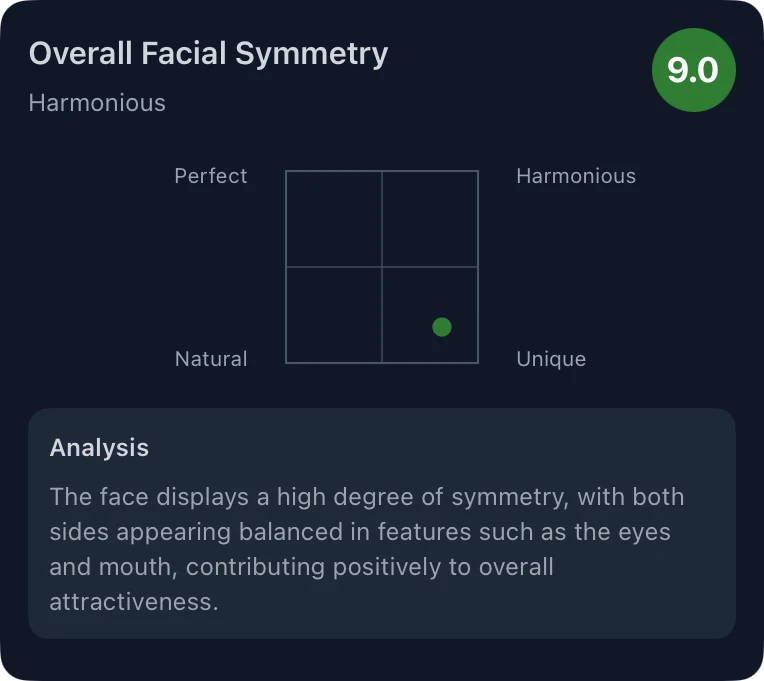
How Our Attractiveness Analysis Works
Get the Maxx Report App
Discover how your facial features influence others' perception and receive personalized insights