
Key Factors Affecting Facial Attractiveness
What makes a face attractive? This question has intrigued scientists, artists, and philosophers for centuries. While beauty standards vary across cultures and change over time, research has identified several universal factors that influence how we perceive facial attractiveness. For an AI-powered analysis of your own facial features, try our Attractiveness Test tool, which provides personalized insights based on these scientific principles.
The Science of Facial Symmetry
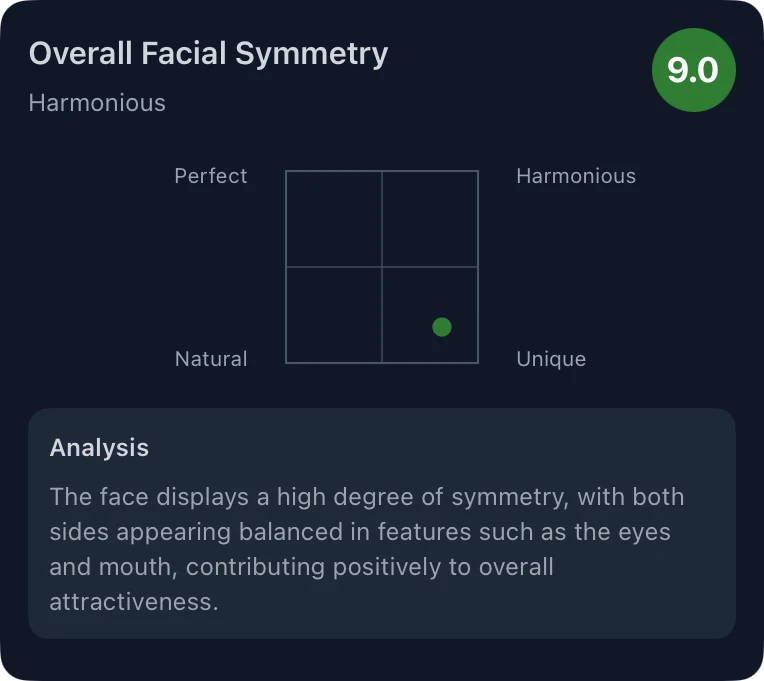
Facial symmetry is one of the most consistently identified factors in attractiveness research. Studies show that we subconsciously perceive symmetrical faces as more attractive because symmetry signals good genetic health and developmental stability. Perfect symmetry is rare in nature, but faces with greater symmetry are generally rated as more attractive across cultures.
Research using computer-generated composite faces has demonstrated that even small improvements in symmetry can significantly increase attractiveness ratings. When researchers create perfectly symmetrical versions of faces (by mirroring either the left or right side), these manipulated images are typically rated as more attractive than the original asymmetrical faces.
Facial Proportions and Averageness
The concept of "averageness" plays a crucial role in facial attractiveness. Studies using computer morphing to create composite faces from many individuals consistently show that these "average" faces are rated as more attractive than most individual faces. This phenomenon occurs because average faces represent the mathematical average of all facial features in a population, eliminating unusual or extreme characteristics.
Key proportions that influence attractiveness include:
- The rule of thirds (facial height divided into equal thirds)
- Ideal face width-to-height ratio (approximately 3:4)
- Balanced facial thirds (forehead, nose to mouth, mouth to chin)
- Ideal distance between the eyes (approximately one eye-width)
- Balanced lip proportions (upper lip to lower lip ratio)
Our How Attractive Am I? tool analyzes these proportions using advanced facial recognition algorithms to provide an objective assessment of your facial harmony.
Sexual Dimorphism: Masculine and Feminine Features
Sexual dimorphism refers to the distinct differences between typical male and female facial characteristics. For men, features shaped by testosterone during development—such as a pronounced brow ridge, stronger jawline, and larger chin—signal genetic fitness. For women, estrogen-influenced features like larger eyes, fuller lips, higher cheekbones, and a smaller jaw are typically associated with attractiveness.
Interestingly, studies have shown that preferences for sexual dimorphism can vary depending on cultural factors, individual differences, and even where women are in their menstrual cycle. Some research suggests that women may prefer more masculine features for short-term relationships and slightly more feminine male features for long-term partners.
Skin Quality and Youthfulness
Skin condition is a powerful indicator of health, youth, and genetic quality, making it a significant factor in facial attractiveness. Clear, smooth, evenly-colored skin is universally associated with attractiveness across cultures. Research has shown that skin homogeneity (evenness of skin tone) can be even more important than facial features in some contexts.
Key aspects of attractive skin include:
- Smoothness and absence of blemishes
- Even coloration and absence of discoloration
- Healthy coloration (slight redness from blood circulation)
- Adequate hydration reflected in skin "glow"
- Absence of excessive oiliness or dryness
Advanced imaging technology can now assess skin quality at levels beyond what is visible to the naked eye, revealing subsurface damage and early signs of aging.
Facial Feature Size and Placement
The size and placement of individual facial features significantly influence overall attractiveness. Research has identified several key relationships between features that contribute to an attractive appearance:
Eyes
Larger eyes relative to face size are generally perceived as more attractive, particularly in women. The distance between eyes ideally equals approximately one eye width. Eyes set too close together or too far apart can disrupt facial harmony. Eye shape also plays a role, with slight upward tilt at the outer corners often rated as attractive.
Nose
A straight nose with moderate width that balances well with other facial features is typically considered attractive. The ideal nose is neither too large nor too small for the face. The angle between the nose and upper lip (nasolabial angle) influences perceived attractiveness, with slightly upturned noses often preferred for women and straighter profiles for men.
Lips
Fuller lips with well-defined borders are generally associated with attractiveness, particularly for women. The ratio between upper and lower lip is important, with the lower lip ideally being slightly fuller than the upper lip. The width of the mouth relative to other facial features contributes to overall harmony.
Jawline and Chin
A well-defined jawline signals genetic health and proper development. For men, a stronger, more angular jaw is typically considered attractive, while women's attractiveness is often enhanced by a more delicate, V-shaped lower face. Chin projection should balance with the forehead and nose when viewed in profile.
Neoteny and Youthful Features
Neoteny refers to the retention of youthful characteristics into adulthood. Certain childlike facial features—large eyes, small nose, full lips, and smooth skin—are associated with attractiveness, particularly in women. These features trigger nurturing responses and signal youth and fertility.
Research suggests that faces with a moderate degree of neoteny combined with mature features are often rated as most attractive. This "baby face" effect is more pronounced in evaluations of female attractiveness but plays a role in male attractiveness as well, particularly in certain cultures.
The Golden Ratio in Facial Attractiveness
The golden ratio (approximately 1.618:1) appears repeatedly in assessments of facial attractiveness. This mathematical ratio, found throughout nature, seems to play a role in how we perceive beauty. Studies have found that faces whose proportions more closely adhere to the golden ratio are typically rated as more attractive.
Key golden ratio relationships in the face include:
- The ratio of face length to face width
- The position of eyes relative to overall face height
- The distance between the eyes and mouth relative to face length
- The width of the nose relative to the distance between the eyes
- The ratio of the width of the mouth to the width of the nose
While perfect adherence to the golden ratio is rare in natural faces, greater conformity to these proportions is associated with higher attractiveness ratings.
Facial Expressiveness and Dynamic Attractiveness
Research increasingly recognizes that static facial features are only part of the equation. Dynamic aspects of the face—how it moves during expressions—significantly influence perceived attractiveness. A naturally expressive face with positive emotional displays (genuine smiles, animated expressions) can dramatically increase attractiveness ratings.
Studies utilizing video ratings rather than static photographs have found that expressiveness can sometimes override structural features in attractiveness judgments. Positive expressions signal social approachability and emotional health, which are desirable traits in social and romantic partners.
Cultural and Individual Variation
While many attractiveness factors appear universal, there are notable cultural and individual variations in beauty standards. Research across diverse populations has found that while core principles like symmetry and averageness are consistent, the ideal expression of these principles can vary.
For example, preferences for body weight, skin tone, and specific facial features show cultural variation. These differences reflect environmental adaptations, cultural values, and historical influences. However, the underlying principles of harmony, balance, and health signals remain remarkably consistent.
The Role of Familiarity and Exposure
The "mere exposure effect" plays a significant role in attractiveness judgments. We tend to develop preferences for faces that resemble those we're frequently exposed to, including family members and prevalent facial types in our community. This explains some cultural variations in beauty standards and the common observation that couples often share facial similarities.
Research has found that we're more likely to be attracted to faces that represent a composite of faces we've been exposed to throughout our lives. This helps explain why "average" faces are generally rated as attractive—they represent familiar patterns our brains have learned to recognize.
Gender Differences in Attractiveness Perception
Men and women don't always evaluate facial attractiveness using the same criteria. Research has found that men typically place more emphasis on physical attractiveness in mate selection across cultures. They tend to value neotenic features and signs of youth and fertility more highly.
Women, while still valuing physical attractiveness, often place greater emphasis on status cues and personality signals derived from facial features. They may pay more attention to facial expressions, perceived intelligence, and kindness markers when evaluating male attractiveness.
Modern Science and AI in Attractiveness Analysis
Advanced technologies have revolutionized our understanding of facial attractiveness. AI algorithms can now analyze thousands of facial data points to identify patterns associated with attractiveness ratings. These systems have confirmed many traditional attractiveness factors while revealing subtle relationships previously undetectable to human researchers.
Our Attractiveness Test utilizes advanced AI technology to analyze facial features according to established scientific principles of attractiveness. It evaluates factors like symmetry, proportions, feature placement, and harmony to provide an objective assessment of facial aesthetics.
Attractiveness Analysis Features

How Our Attractiveness Analysis Works
Get the Maxx Report App
Discover your attractiveness score and personalized enhancement recommendations